Check-up And Clean
Check-up and clean appointments are covered by selected health insurance funds.
phone Book Your VisitCheck-up and clean appointments are covered by selected health insurance funds.
phone Book Your VisitRegular check-ups and cleanings are essential for maintaining oral health. They help prevent problems, detect issues early, and keep your teeth and gums healthy. At K Family Dental, our services are tailored to meet your specific needs.
Highly skilled dentists and dedicated staff
Dental plaque is a sticky layer formed when bacteria in the mouth combine with saliva, food particles, and dead cells. Over time, its accumulation can lead to tooth decay by damaging the enamel surface. If left untreated, plaque hardens into tartar (also known as calculus), which can build up above and below the gum line. Since tartar harbours bacteria, it may irritate the gums and lead to gingivitis (gum inflammation and bleeding). Without intervention, this can progress to periodontitis, a more advanced form of gum disease that damages the bone supporting the teeth, potentially resulting in loose teeth.
Cavities or holes in the teeth can worsen if they reach the dental pulp (nerve). This stage often requires more invasive treatments, such as root canal therapy or, in severe cases, tooth extraction or other surgical procedures.
Even with thorough oral hygiene practices, it is not possible to completely remove tartar at home. Dentists use specialised tools to clean hard-to-reach areas, including below the gum line and between teeth. Therefore, scheduling a dental check-up and professional cleaning every six months is essential for maintaining optimal oral health.
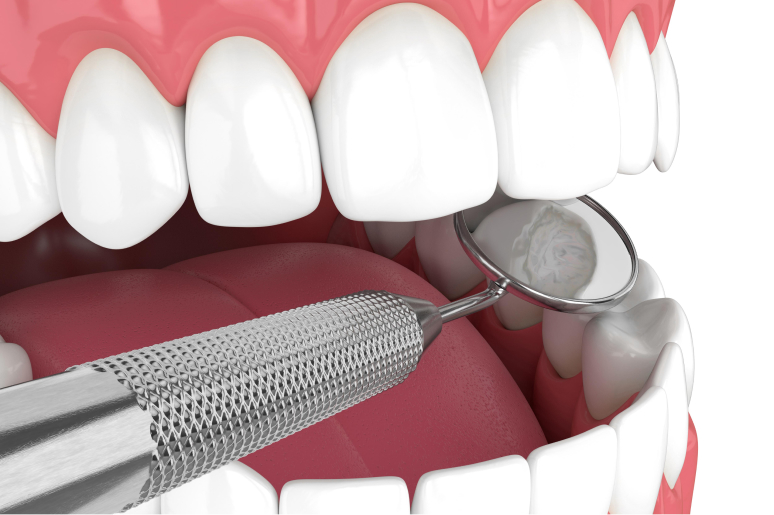
Regular check-ups are essential to prevent problems, detect issues like cavities in their initial stages, and maintain gum health. Furthermore, it is not possible to completely remove tartar at home; dentists use specialised tools to clean hard-to-reach areas below the gum line to maintain optimal oral health.
Dental plaque is a sticky layer formed by bacteria, saliva, food particles, and dead cells that can damage enamel and lead to tooth decay. If left untreated, plaque hardens into tartar, which harbours bacteria and can cause gingivitis and periodontitis.
If untreated, gum inflammation (gingivitis) can progress to periodontitis, an advanced form of gum disease that damages the bone supporting the teeth, potentially resulting in loose teeth.